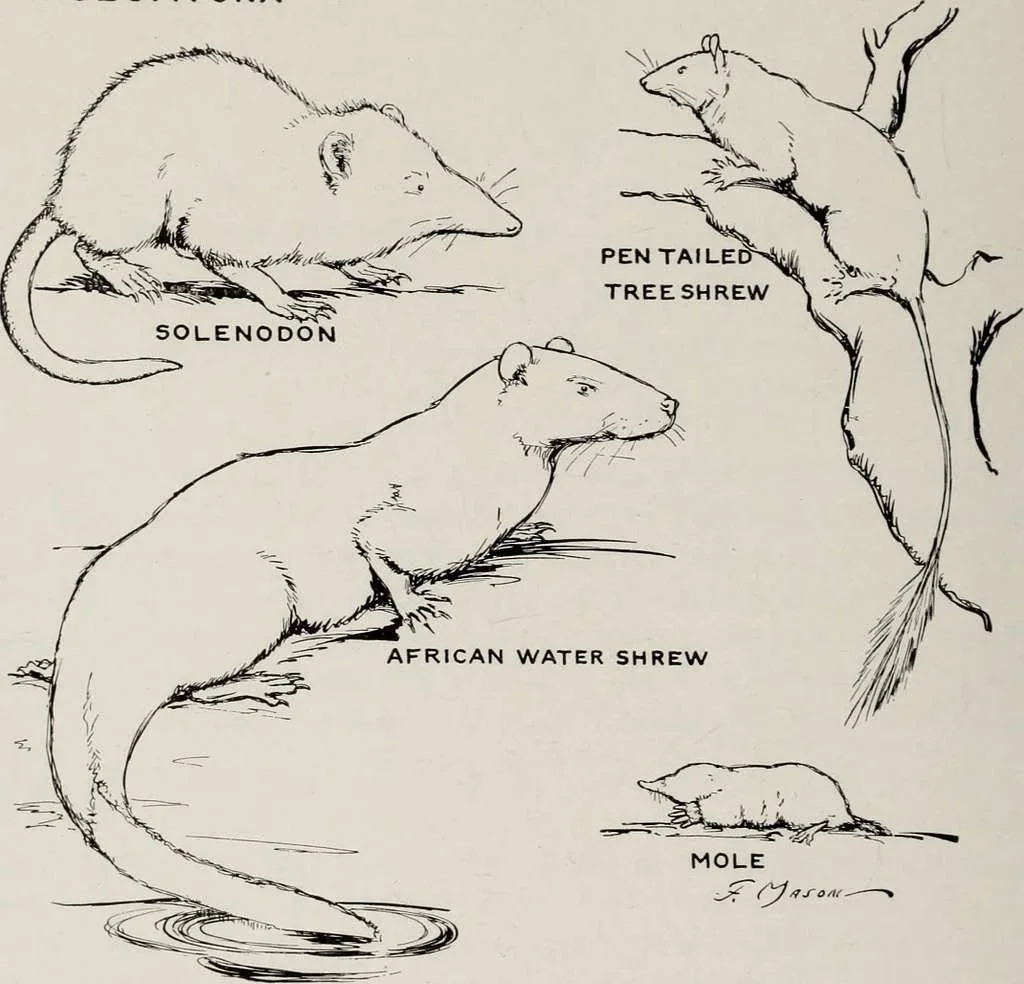
Living small in the water.
Do mammalian bone material properties respond predictably when extreme body size and extreme ecology interact?
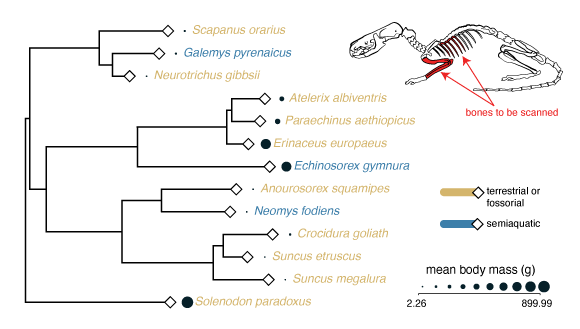
In mammals, miniaturization is an ecomorphological extreme. Living life at a tiny size imposes distinct physical and functional demands, altering the selective pressures acting on the skeleton, and at the extremes of body size, broadly-applicable scaling laws break down.
The clade Eulipotyphla contains the smallest extant mammal as well as multiple independent transitions to the aquatic environment. Small body size intensifies the challenges of aquatic living, as high surface-area-to-volume ratios exacerbate heat loss and increase buoyant forces – intensified by air retention in fur and lungs. Under such conditions, skeletal material properties may adapt to mitigate energetic costs by increasing bone density or by enhancing stiffness (to yield more efficient underwater maneuvering). However, these adaptations may be detrimental at such tiny body sizes. Semi-aquatic eulipotyphlan species provide a rare opportunity to test whether bone material properties respond predictably when extreme body size and extreme ecology interact.
Figure modified from Smith et al. 2024