
Adaptive convergence in fishes
Adaptive convergence is when specific ecological pressures lead to similar traits in independent lineages. When a functional challenge is solved multiple times across the tree if life, we can begin to illuminate the drivers of those changes. However, studies of convergence commonly focus on computationally manageable clades that often lack the replication necessary to fully parse the influence of ecology, evolutionary history, and chance. This raises an important questions, can adaptive convergence overcome effects of evolutionary history and chance at large phylogenetic scales?
We investigated these questions in the feeding ecologies of fishes, specifically looking at the functional demands of a planktivorous diet. We test whether selective planktivores within disparate clades have converged on a common morphology to be successful at finding and eating plankton.
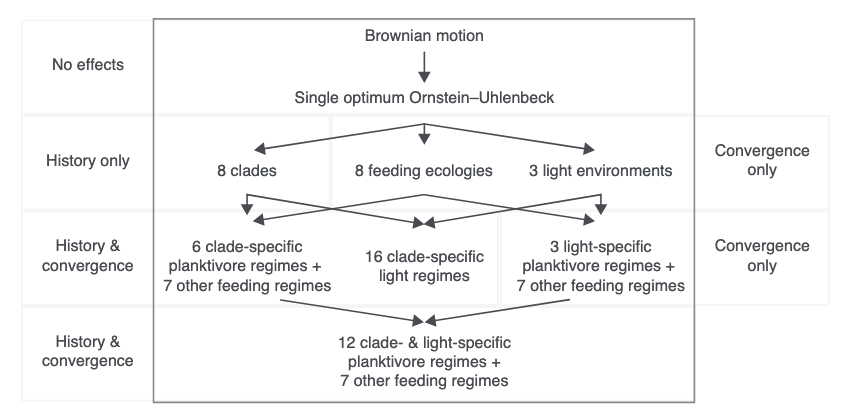
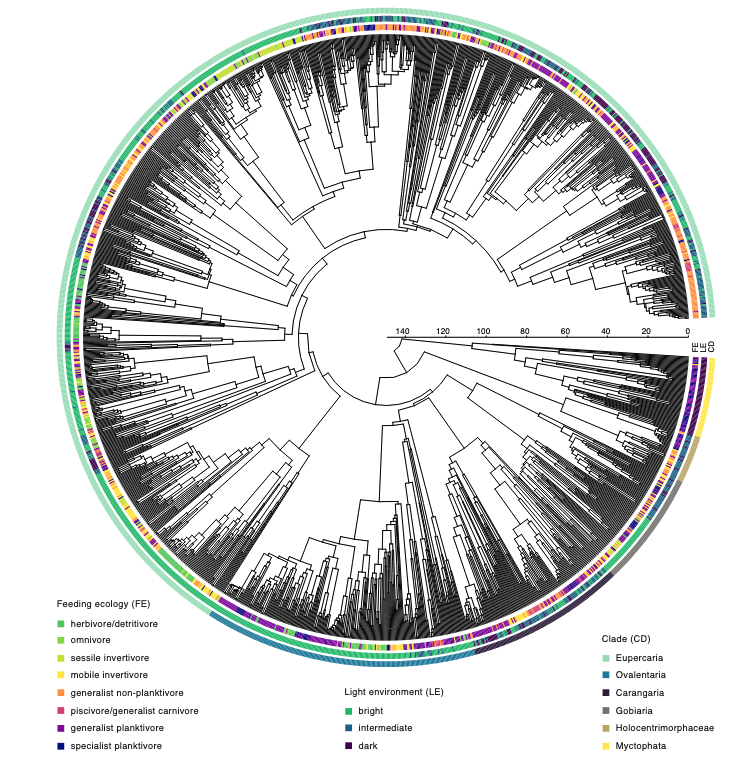
But adaptive responses are complex - so in this case, we assessed how fish phenotypes evolved in response to both feeding and light environment. Vision is an important sense for planktivores because their prey is very small, but the amount of light in a species’s habitat is highly dependent on the depth at which they live. We wanted to to determine whether eye size, for example, has evolved primarily in response to selective pressures associated with feeding or the light environment in which species feed, or a combination of both.
Check out the manuscript, lead by Dr. Jennifer R Hodge